
Designed specifically for foundations
Everyone who speaks for your foundation, from staff and leaders to agencies and vendors, held to the voice you chose and tested on your donors before anything goes out. Human-led, and unmistakably yours.
Your ideal voice
Most AI tools learn your voice from what you've already published. That just teaches them to repeat today: the committee edits, the institution's marketing tone, the habits nobody chose.
Our Voice Lab starts somewhere else. In a working session with your team we set where the foundation wants to sit on each dial, then every draft, from every writer, is measured against that ideal and pulled toward it.
Illustrative. Your dials are set in your voice workshop.
Your voice, in practice
Every draft is checked against the words your foundation reaches for and the signals it avoids. Here's what that does to lines foundations use every day.
Your community's most trusted partner.
Boastful: breaks the confidence guardrailProven through fire, flood, and every day in between. Trust earned right here.
Leveraging resources to maximize community impact.
Corporate jargon: nobody talks like thisYour gift stays close to home: the classroom down the street, the shelter across town, the neighbor you'll never meet.
Act now, before it's too late. Without your gift, families will suffer.
Guilt-driven: obligation over inspirationTonight a family will sleep in a warm room your neighbors paid for. Your gift keeps the light on for the next one.
Act now · Last chance · For just $X a day
Invitation: join, stand with, help make possible
You owe · Before it's too late · Desperate
Hope and agency: your gift makes ___ possible
Best · #1 · Unmatched · Premier
Earned proof: proven, trusted, tested
Leverage · Best-in-class · Stakeholders
Plain, concrete language and real stories
Just · If you can · Sorry to bother
Direct verbs: lead, build, champion
Illustrative examples. Your allow list, block list and rewrite rules are set with your team.
One workspace, loaded with your brand voice, your regions, your vocabulary and your photography principles — so every piece is judged, and written, against the same standard.
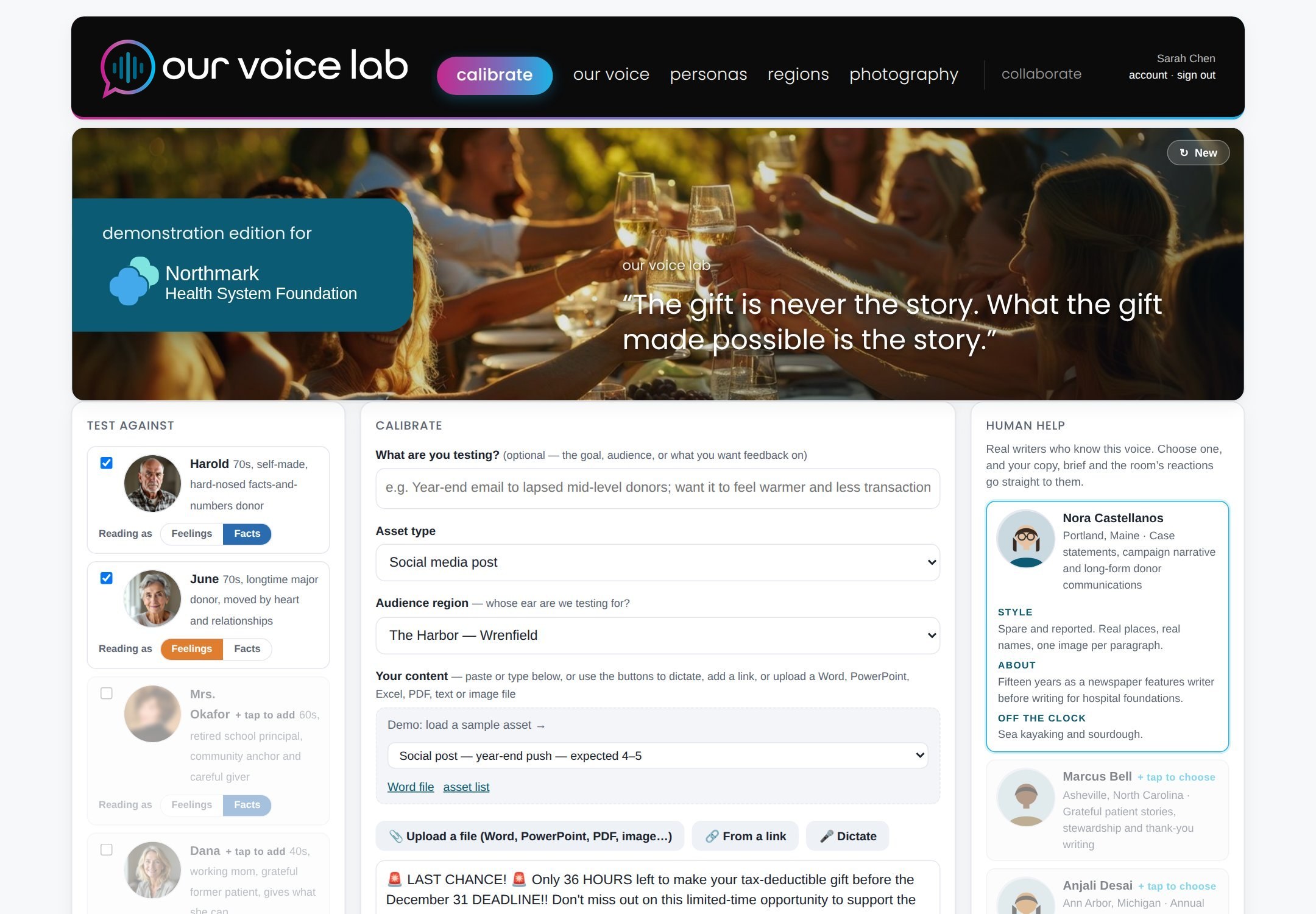
Paste copy or drop in a Word file, PDF, deck or image. Pick the donors in the room — the skeptical retiree, the lifelong supporter, the first-time donor, the young neighbor — and the region you're writing to. Get a score, the reactions in their own words, and the single highest-impact fix.
An AI collaboration space for the people you choose. Grant access to members of your team and they can research with cited sources, brainstorm, and build examples to trace from, in a room that has already read your brand standards, personas and word banks. Save assets and export to Word, PowerPoint or Markdown.
When a piece matters, send it — with the brief, the copy and the room's reactions — straight to a human writer who knows your voice. They pick up where the tool leaves off.
Every foundation has donors no stock persona captures. Build your own in a couple of minutes, and they join the room for every test from then on: reacting in their own words, scoring every draft, telling you what would win them over.
We build your core personas with you during onboarding. After that, anyone on the team can add the donor they're about to write for.

Thirty years of making payroll taught him that good intentions don't fix a roof. He'll give to the thing he can drive past and see working.
"Don't tell me you're making a difference. Tell me what it cost, what you fixed, and who's going to be there next year."
Why human-led matters
Your readers already start from suspicion: only 18% of people have high trust in charities, and that number hasn't moved since 2017. AI can help you earn that trust or spend it. It depends on where you use it.
Research, sorting, flagging, fact-checking, finding the story.
The AI writes nothing the donor reads, so there's nothing to disclose.
Headlines, rewrites, tone edits, "tightening" a draft.
Donor comfort drops from 55% to 30–41%, and "AI only proofread" wins none of it back.
AI-drafted appeals, thank-yous, images, avatars, chatbots.
Comfort falls to 19–26%, and 31% of donors say they would give less.
Donors don't object to AI. They object to not knowing who's speaking.
Some work is simply better with an AI partner. Collaborate brings that in, guided and protected in ways that freelancing in a personal chatbot can't be.
AI helps your people think, research and try ideas. It never speaks for you. Your team writes, the room reacts, and a human signs every piece.
Sources: Give.org Donor Trust Report 2026; Reuters Institute, Generative AI and News 2025; Chappell & Koshy, survey of 1,006 US donors, 2024; Schilke & Reimann 2025. Tier costs are ranges read across studies, not a single measurement.
Most foundations don't have a voice problem. They have a twelve-people-writing-in-twelve-voices problem. Our Voice Lab fixes that.
Your brand voice, word banks and audience personas live in the tool, not in one person's head. New staff, agencies and volunteers write like the foundation from day one.
Every piece is read by a room of your audiences at once, so feedback reflects how a community actually hears you instead of whoever reviewed the draft last.
The appeal, the annual report, the CEO's remarks and the social post all get held to the same standard, so a donor never hears three different foundations in one month.
Test the same idea for donors, for the community, for volunteers and partners, for a specific region, and see where it needs to change before it goes out.
Everyone who writes for the foundation brings their own habits. Our Voice Lab runs every draft through the same filters and the same guardrails, so what reaches the donor sounds like one foundation.
Your brand standards, visual identity and institutional voice stay exactly where they are. Our Voice Lab sits on top of them as a filter and a guardrail: it carries your brand into every draft, then adds the foundation's own voice, the words you reach for, the signals you avoid and the donors you're speaking to.
The result is work that is always on brand, and always sounds like philanthropy rather than marketing.
From your audience research and a Voice of Philanthropy workshop, we create your donor personas, regional lenses and brand-voice calibration.
Everyone who writes for the foundation gets a login. Nothing to install; it works in the browser with the files you already use.
Run a draft, read the reactions, apply the fix, run it again, until it sounds like the foundation you chose to be.
Cases, campaign pieces and the appeal that has to work go to a human writer with the whole thread attached.
Collective learning
A style guide is finished the day it's printed. Your voice lab keeps learning. Every draft, every score and every result becomes shared knowledge, and the levers keep improving.
Staff, leaders and vendors run their work through the same room and the same standard.
What landed, what fell flat and what got flagged is saved where the whole team can see it.
Real outcomes, the appeal that worked, the story that moved a donor, are reviewed with your team.
Dials, word banks, personas and rewrite rules are refined with your team, so the standard rises.
When a gift officer finds the line that works, the whole team inherits it.
A phrase that falls flat gets flagged for everyone, not rediscovered by the next writer.
New staff, agencies and vendors begin with everything the foundation has already learned.
Not just the people with "communications" in their title. Every role on a foundation team has moments when it has to say, clearly and in the foundation's voice, what makes this place and the people who work here special. Our Voice Lab helps each of them do that.
"Brave but never boastful, inspirational over obligatory, warm over formal, earned not inherited." That is a foundation's voice in one line. Our Voice Lab helps everyone who speaks for the foundation hold to it.— from a client brand-voice calibration
Bring an appeal, a case or a post you're working on. In thirty minutes you'll watch a room of donors react to it — and leave with a better version.
Book a demoOr write to hello@ourvoicelab.com